


Fast, stack-allocated linear algebra for fixed dimensions in Rust.
This crate grew from the need to support delaunay with fast, stack-allocated linear algebra primitives and algorithms
while keeping the API intentionally small and explicit.
la-stack provides a handful of const-generic, stack-backed building blocks:
Vector<const D: usize>for fixed-lengthf64vectors backed by[f64; D]Matrix<const D: usize>for fixed-size squaref64matrices backed by[[f64; D]; D]Lu<const D: usize>for LU factorization with partial pivoting (solve + det)Ldlt<const D: usize>for no-pivot factorization intended for exactly symmetric positive-definite matrices (solve + det; typed pivot diagnostics)
la-stack operates on finite IEEE 754 binary64 values in small, fixed
dimensions. Its floating-point paths use LU with partial pivoting, LDLT without
pivoting for exactly symmetric positive-definite matrices, and closed-form
determinants through D=4. These results remain subject to conditioning and
binary64 rounding;
factorization tolerances are rejection thresholds, not accuracy guarantees. For
D≤4, direct determinants can be paired with a conservative absolute roundoff
bound when its range preconditions hold.
With features = ["exact"], stored binary64 inputs are lifted losslessly to
rationals for exact determinant signs, determinant values, and solves. Exactness
starts at the stored values and cannot recover information rounded away before
construction. See the
mathematical basis
for the algorithms, validity boundaries, and supporting references.
- ✅
Copytypes where possible - ✅ Const-generic storage (no dynamically sized matrix or vector representation)
- ✅
const fnwhere possible (compile-time evaluation of determinants, dot products, etc.) - ✅ Explicit algorithms (LU, solve, determinant)
- ✅ Error-bounded f64 determinant filtering plus optional exact signs
(
det_errbound,det_sign_exact) - ✅ Exact determinant values and linear solves via optional arbitrary-precision
arithmetic (
det_exact,solve_exact, strict/rounded f64 conversions) - ✅ No runtime dependencies by default (optional features may add deps)
- ✅ Inline, stack-backed storage for core types; optional arbitrary-precision exact values allocate as required
- ✅
unsafeforbidden
See CHANGELOG.md for release history and docs/roadmap.md for current release planning.
- Bare-metal performance: see
blas-src,lapack-src, oropenblas-src - Broad general-purpose linear algebra: use
nalgebra - Large matrices/dimensions with parallelism: use
faer - Alternate floating-point scalar families:
la-stacksupportsf64and optional exact arithmetic, notf32/f16APIs
- Your matrices and vectors have small, fixed dimensions known at compile time
- Stack allocation and
Copyvalue semantics fit your data flow - You want explicit LU / LDLT / determinant APIs rather than a broad algebra toolkit
- You need exact determinants, exact determinant signs, or exact linear solves for fixed-size systems
- Robust predicates matter for geometry-style workloads near degeneracy
- You prefer a default build with no runtime dependencies
The scalar model is intentionally limited to f64 for floating-point work and
exact rationals behind the optional "exact" feature. This matches the crate's
focus on small, robustness-sensitive numerical and computational geometry
workloads. When f64 precision is insufficient (e.g. near-degenerate geometric
configurations), the optional "exact" feature provides arbitrary-precision
arithmetic via BigRational (see below).
Lower-precision f32 / f16 throughput-oriented workloads are outside the
crate's scope; they usually indicate large-matrix or accelerator-oriented use
cases better served by broader linear-algebra libraries.
Add this to your Cargo.toml:
[dependencies]
la-stack = "0.4.3"default: no runtime dependenciesexact:BigRationalexact determinant and solve APIsbench: repository-development gate used only by benchmark targets and benchmark-input tests; application crates should not enable it
Solve a 5×5 system via LU:
use la_stack::prelude::*;

fn main() -> Result<(), LaError> {
    // This system requires pivoting (a[0][0] = 0), so it's a good LU demo.
    // A = J - I: zeros on diagonal, ones elsewhere.
    let a = Matrix::<5>::try_from_rows([
        [0.0, 1.0, 1.0, 1.0, 1.0],
        [1.0, 0.0, 1.0, 1.0, 1.0],
        [1.0, 1.0, 0.0, 1.0, 1.0],
        [1.0, 1.0, 1.0, 0.0, 1.0],
        [1.0, 1.0, 1.0, 1.0, 0.0],
    ])?;

    let b = Vector::<5>::try_new([14.0, 13.0, 12.0, 11.0, 10.0])?;

    let lu = a.lu(DEFAULT_SINGULAR_TOL)?;
    let x = lu.solve(b)?.into_array();

    // Floating-point rounding is expected; compare with a tolerance.
    let expected = [1.0, 2.0, 3.0, 4.0, 5.0];
    for (x_i, e_i) in x.iter().zip(expected.iter()) {
        assert!((*x_i - *e_i).abs() <= 1e-12);
    }

    Ok(())
}Compute a determinant for a symmetric positive-definite matrix via LDLT (no pivoting).
For these matrices, LDLᵀ is a square-root-free Cholesky form. Multiplying each
column of L by the square root of the corresponding diagonal entry yields a
Cholesky factor:
use la_stack::prelude::*;

fn main() -> Result<(), LaError> {
    // This matrix is symmetric positive-definite (A = L*L^T) so LDLT works without pivoting.
    let a = Matrix::<5>::try_from_rows([
        [1.0, 1.0, 0.0, 0.0, 0.0],
        [1.0, 2.0, 1.0, 0.0, 0.0],
        [0.0, 1.0, 2.0, 1.0, 0.0],
        [0.0, 0.0, 1.0, 2.0, 1.0],
        [0.0, 0.0, 0.0, 1.0, 2.0],
    ])?;

    let ldlt = match a.ldlt(DEFAULT_SINGULAR_TOL) {
        Ok(ldlt) => ldlt,
        Err(err @ LaError::Asymmetric {
            row,
            col,
            upper,
            lower,
            allowed_abs_diff,
            ..
        }) => {
            eprintln!(
                "LDLT mismatch at ({row}, {col}): {upper} vs {lower} (allowed {allowed_abs_diff})"
            );
            return Err(err);
        }
        Err(err) => return Err(err),
    };

    let det = ldlt.det()?;
    assert!((det - 1.0).abs() <= 1e-12);

    Ok(())
}
⚠️ LDLT invariant: The input matrix must be exactly symmetric: every mirrored pair must compare equal (+0.0 == -0.0is accepted). Asymmetric inputs passed toMatrix::ldltreturn a typedLaError::Asymmetriccontaining both observed values and the required allowed difference of zero. The tolerance-basedMatrix::first_asymmetryandMatrix::is_symmetricmethods remain useful diagnostics, but do not prove the exact precondition required by LDLT. Uselu()when exact symmetry or positive definiteness is not guaranteed. A negative LDLT diagonal or a zero diagonal with nonzero remaining coupling returnsLaError::NotPositiveSemidefinitewith a typedPositiveSemidefiniteViolation. An uncoupled zero or positive pivot at or below the caller's tolerance returnsLaError::Singularwith a numericalSingularityReason. Because these pivots are computed in binary64, success is not an exact positive-definiteness certificate for the stored matrix.
det_direct() is a const fn providing closed-form determinants for D=0–4,
using fused multiply-add where applicable. It returns Ok(Some(det)) for those
dimensions and Ok(None) for D ≥ 5. Matrix::<0>::zero().det_direct() returns
Ok(Some(1.0)) (the empty-product convention). For D=1–4, direct formulas
bypass LU factorization entirely. This enables compile-time evaluation when
inputs are known:
use la_stack::prelude::*;

// Evaluated entirely at compile time — no runtime cost.
const DET: Result<Option<f64>, LaError> = match Matrix::<4>::try_from_rows([
    [2.0, 0.0, 0.0, 0.0],
    [0.0, 3.0, 0.0, 0.0],
    [0.0, 0.0, 5.0, 0.0],
    [0.0, 0.0, 0.0, 7.0],
]) {
    Ok(matrix) => matrix.det_direct(),
    Err(err) => Err(err),
};

fn main() -> Result<(), LaError> {
    assert_eq!(DET?, Some(210.0));
    Ok(())
}
The public det() method automatically dispatches through the closed-form path
for D ≤ 4 and falls back to zero-tolerance LU for D ≥ 5. Tiny nonzero
determinants are not flattened by a configured pivot tolerance. The LU fallback
returns LaError::Singular when floating-point elimination cannot produce a
non-zero pivot; it does not misreport that numerical failure as an exact zero.
Use lu() directly when you need a different tolerance policy, and use the
exact determinant APIs when exact singularity classification matters.
The default build has zero runtime dependencies. Enable the optional
exact Cargo feature to add exact arithmetic methods using arbitrary-precision
rationals (this pulls in num-bigint, num-rational, and num-traits for
BigRational):
[dependencies]
la-stack = { version = "0.4.3", features = ["exact"] }
These routines are exact with respect to the finite binary64 values stored in
Matrix and Vector. They treat each stored value as the exact rational number
represented by its bits, so the exact determinant or solve stage introduces no
further roundoff. They cannot recover information already lost when source
values were rounded to f64 before construction.
Determinants:
det_exact()— returns the exact determinant as aBigRationaldet_exact_f64()— returns the exact determinant asf64only when it is exactly representable (orLaError::Unrepresentableotherwise)det_exact_rounded_f64()— returns the exact determinant rounded to a finitef64using IEEE 754 round-to-nearest, ties-to-evendet_sign_exact()— infallibly returns the provably correctDeterminantSignvariant (Negative,Zero, orPositive)
Linear system solve:
solve_exact(b)— solvesAx = bexactly, returning[BigRational; D]solve_exact_f64(b)— solvesAx = bexactly, returningVector<D>only when every component is exactly representable asf64solve_exact_rounded_f64(b)— solvesAx = bexactly, returning each component rounded to finitef64using IEEE 754 round-to-nearest, ties-to-evenExactF64Conversion— converts an existing exact determinant or solution under the strict or rounded contract without repeating exact elimination
For exact-to-f64 output, strict conversions use
UnrepresentableReason::RequiresRounding when explicit rounding can produce a
finite value and UnrepresentableReason::NotFinite otherwise. Rounded
conversions opt into nearest-even rounding but still report NotFinite when no
finite f64 exists.
use la_stack::prelude::*;

fn main() -> Result<(), LaError> {
    // Exact determinant
    let m = Matrix::<3>::try_from_rows([
        [1.0, 2.0, 3.0],
        [4.0, 5.0, 6.0],
        [7.0, 8.0, 9.0],
    ])?;
    assert_eq!(m.det_sign_exact(), DeterminantSign::Zero); // exactly singular

    let det = m.det_exact()?;
    assert_eq!(det, BigRational::from_integer(0.into())); // exact zero
    let det_f64 = det.try_to_f64()?;
    assert_eq!(det_f64, 0.0);

    // If strict exact-to-f64 conversion would require rounding, opt in
    // explicitly with the rounded API.
    let inexact = Matrix::<2>::try_from_rows([
        [1.0 + f64::EPSILON, 0.0],
        [0.0, 1.0 - f64::EPSILON],
    ])?;
    let exact_det = inexact.det_exact()?;
    let rounded_det = match exact_det.try_to_f64() {
        Ok(det) => det,
        Err(err) if err.requires_rounding() => exact_det.to_rounded_f64()?,
        Err(err) => return Err(err),
    };
    assert_eq!(rounded_det.to_bits(), 1.0f64.to_bits());

    // If the exact determinant cannot fit in f64, keep the BigRational value.
    let big = f64::MAX / 2.0;
    let huge = Matrix::<3>::try_from_rows([
        [0.0, 0.0, 1.0],
        [big, 0.0, 1.0],
        [0.0, big, 1.0],
    ])?;
    let huge_det = huge.det_exact()?;
    assert_eq!(
        huge_det
            .try_to_f64()
            .err()
            .and_then(|err| err.unrepresentable_reason()),
        Some(UnrepresentableReason::NotFinite)
    );
    println!("exact determinant = {huge_det}");

    // Exact linear system solve
    let a = Matrix::<2>::try_from_rows([[1.0, 2.0], [3.0, 4.0]])?;
    let b = Vector::<2>::try_new([5.0, 11.0])?;
    let exact_x = a.solve_exact(b)?;
    let x = exact_x.try_to_f64()?.into_array();
    assert!((x[0] - 1.0).abs() <= f64::EPSILON);
    assert!((x[1] - 2.0).abs() <= f64::EPSILON);

    Ok(())
}
With the exact feature enabled, DeterminantSign, ExactF64Conversion,
BigInt, and BigRational are re-exported from the crate root and prelude,
alongside the most commonly needed num-traits items (FromPrimitive,
ToPrimitive, Signed). This lets consumers construct exact values
(BigRational::from_f64, from_i64), query sign (is_positive /
is_negative), and convert back to f64 (try_to_f64, to_rounded_f64, or
the raw to_f64) with a single
use la_stack::prelude::*; — no need to add num-bigint, num-rational,
or num-traits to their own Cargo.toml. Use
DeterminantSign::as_i8() only when numeric −1/0/+1 interoperability is
required.
For det_sign_exact(), D ≤ 4 matrices first use a fast f64 filter
(error-bounded det_direct()) when its rounded intermediates stay in the normal
range or are exact structural zeros. An inconclusive filter falls back to the
same direct determinant expansion in BigInt. D ≥ 5 skips the closed-form
filter and uses fraction-free Bareiss elimination in BigInt.
Because Matrix stores only finite entries, arithmetic range failures in the
filter are inconclusive rather than errors and the exact fallback is total.
det_direct_with_errbound() returns a closed-form determinant together with
the conservative absolute error bound used by the fast filter, computed from
one call that evaluates the determinant once and computes its matching bound.
It returns None when a D ≤ 4 computation may be affected by gradual
underflow, as well as for unsupported D ≥ 5 dimensions.
This method does NOT require the exact feature — it uses pure f64 arithmetic
and is available by default. Use det_errbound() when only the bound is needed.
The paired API enables custom adaptive-precision logic for geometric predicates:
use la_stack::prelude::*;

fn adaptive_det_sign<const D: usize>(
    matrix: &Matrix<D>,
) -> DeterminantSign {
    if let Ok(Some(estimate)) = matrix.det_direct_with_errbound() {
        if estimate.determinant().abs() > estimate.absolute_error_bound() {
            return if estimate.determinant() > 0.0 {
                DeterminantSign::Positive
            } else {
                DeterminantSign::Negative
            };
        }
    }

    matrix.det_sign_exact()
}

fn main() -> Result<(), LaError> {
    let identity = Matrix::<3>::identity();
    assert_eq!(
        adaptive_det_sign(&identity),
        DeterminantSign::Positive
    );

    // A zero determinant cannot pass the f64 sign filter, so this exercises
    // the exact fallback.
    let singular = Matrix::<3>::try_from_rows([
        [1.0, 2.0, 3.0],
        [4.0, 5.0, 6.0],
        [7.0, 8.0, 9.0],
    ])?;
    assert_eq!(adaptive_det_sign(&singular), DeterminantSign::Zero);

    // The f64 filter overflows for this finite matrix, but the exact fallback
    // still resolves its positive determinant sign.
    let big = f64::MAX / 2.0;
    let overflowing = Matrix::<3>::try_from_rows([
        [0.0, 0.0, 1.0],
        [big, 0.0, 1.0],
        [0.0, big, 1.0],
    ])?;
    assert_eq!(
        adaptive_det_sign(&overflowing),
        DeterminantSign::Positive
    );

    Ok(())
}
The error coefficients (ERR_COEFF_2, ERR_COEFF_3, ERR_COEFF_4) are
conservative, dimension-specific constants, not caller-tunable tolerances. The
mathematical basis
documents the bound and states its range preconditions. The constants are explicit
crate-root exports for advanced users who want to compose the same bound:
use la_stack::{ERR_COEFF_2, ERR_COEFF_3, ERR_COEFF_4};. They intentionally stay
out of the common prelude.
| Type | Storage | Purpose | Key methods |
|---|---|---|---|
Vector<D> |
[f64; D] |
Finite fixed-length vector for input and computation | try_new, as_array, into_array, dot, norm2_sq |
Matrix<D> |
[[f64; D]; D] |
Finite square matrix for input and computation | See below |
DeterminantWithErrorBound |
Opaque validated pair | Paired direct determinant and certified absolute bound | determinant, absolute_error_bound |
Lu<D> |
Inline factors + permutation | Factorization for solves/det | solve, det |
Ldlt<D> |
Inline factors | No-pivot SPD factorization for solves/det | solve, det |
Tolerance |
finite non-negative f64 |
Validated numerical threshold | try_new, get |
LaError |
typed variants and reasons | Structured, actionable failure reporting | See error semantics below |
DeterminantSign¹ |
enum | Exact determinant sign | as_i8 |
Storage shown above reflects the intentional f64 scalar model.
For a runtime dimension from 0 through MAX_STACK_MATRIX_DISPATCH_DIM (7),
try_with_stack_matrix! dispatches to a concrete Matrix<N> while preserving
inline stack storage. Larger dimensions return LaError::UnsupportedDimension;
the macro does not introduce a dynamically sized matrix representation.
Matrix<D> key methods: as_rows, into_rows, lu, ldlt, det,
det_direct, det_direct_with_errbound, det_errbound,
det_exact¹, det_exact_f64¹, det_exact_rounded_f64¹, det_sign_exact¹,
solve_exact¹, solve_exact_f64¹, solve_exact_rounded_f64¹.
Matrix and vector constructors validate non-finite inputs at public API
boundaries. After construction, Matrix<D> and Vector<D> carry that
finite-storage invariant directly, so factorization kernels do not repeat an
O(D²) input scan. Computed factor matrices are still checked before they become
observable results.
Matrix::as_rows and Vector::as_array borrow their validated backing arrays;
Matrix::into_rows and Vector::into_array consume the value and return the
owned fixed-size arrays.
Matrix::get(row, col) returns None for out-of-bounds coordinates;
Matrix::try_get instead returns a structured LaError preserving those
coordinates. The single fallible Matrix::set validates both coordinates and
finiteness before mutating the matrix.
LaError and its reason/location enums are non-exhaustive. Numerical
singularity records the FactorizationKind,
observed pivot magnitude, and tolerance, while exact-arithmetic singularity is
identified separately. LaError::NonFinite retains the crate-wide non-finite
contract but uses NonFiniteOrigin, NonFiniteLocation, and
ArithmeticOperation to distinguish invalid inputs from computed overflow.
InvalidToleranceReason distinguishes negative from non-finite tolerances, and
PositiveSemidefiniteViolation distinguishes negative LDLT pivots from a zero
pivot with nonzero coupling. Match these public enums with a wildcard and use
.. for struct-style variants so future error context can be added without
breaking callers.
¹ Requires features = ["exact"].
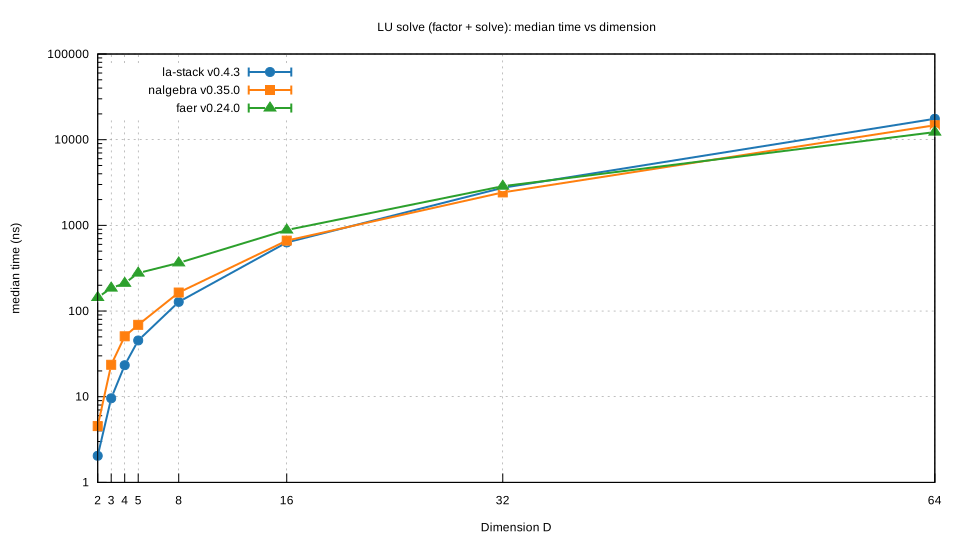
Raw data: docs/assets/bench/vs_linalg_lu_solve_median.csv Historical provenance status: docs/assets/bench/vs_linalg_lu_solve_median.provenance.json
Representative benchmark: lu_solve factors the matrix and solves one
right-hand side. Median time is lower-is-better, and the “la-stack vs
nalgebra/faer” columns show the % time reduction relative to each baseline
(positive means the recorded la-stack median is lower). These are descriptive
point-estimate ratios, not statistical significance claims or an aggregate score
across operations.
Timings count only when the implementation preserves the documented
correctness guarantees and invariants. Performance claims require comparable
before-and-after evidence using the same inputs, configuration, and environment.
This v0.4.3 snapshot predates deterministic measurement-provenance capture, so
its CPU, operating system, Rust toolchain, exact measured source state,
dependency lock digest, and Criterion configuration are unavailable. The CSV
preserves confidence bounds, but without the missing configuration and
environment they do not make the result reproducible across environments. Treat
it as a historical snapshot, not reproducible cross-environment evidence. Future
just plot-vs-linalg-readme publications run the benchmark-input correctness
gate, require complete canonical-dimension coverage, and write deterministic
JSON provenance beside the CSV and SVG.
For the full per-kernel comparison methodology, input construction, and release-comparison workflow details, see docs/BENCHMARKING.md. For the current release-to-release performance snapshot, see docs/PERFORMANCE.md.
| D | la-stack median (ns) | nalgebra median (ns) | faer median (ns) | la-stack vs nalgebra | la-stack vs faer |
|---|---|---|---|---|---|
| 2 | 2.044 | 4.542 | 143.958 | +55.0% | +98.6% |
| 3 | 9.596 | 23.599 | 185.466 | +59.3% | +94.8% |
| 4 | 23.338 | 50.717 | 210.976 | +54.0% | +88.9% |
| 5 | 45.368 | 69.065 | 277.564 | +34.3% | +83.7% |
| 8 | 127.861 | 164.412 | 364.864 | +22.2% | +65.0% |
| 16 | 631.997 | 663.822 | 882.674 | +4.8% | +28.4% |
| 32 | 2,745.604 | 2,424.540 | 2,867.431 | -13.2% | +4.2% |
| 64 | 17,543.034 | 14,747.731 | 12,266.271 | -19.0% | -43.0% |
The examples/ directory contains small, runnable programs:
solve_5x5— solve a 5×5 system via LU with partial pivotingdet_5x5— determinant of a 5×5 matrix via LUldlt_solve_3x3— solve a 3×3 symmetric positive definite system via LDLTconst_det_4x4— compile-time 4×4 determinant viadet_direct()exact_det_3x3— exact determinant value of a near-singular 3×3 matrix (requiresexactfeature)exact_sign_3x3— exact determinant sign of a near-singular 3×3 matrix (requiresexactfeature)exact_solve_3x3— exact solve of a near-singular 3×3 system vs f64 LU (requiresexactfeature)
just examples
# or individually:
cargo run --example solve_5x5
cargo run --example det_5x5
cargo run --example ldlt_solve_3x3
cargo run --example const_det_4x4
cargo run --features exact --example exact_det_3x3
cargo run --features exact --example exact_sign_3x3
cargo run --features exact --example exact_solve_3x3A short contributor workflow:
Install Rust 1.97.0 through rustup, Git, Python 3.14,
uv 0.11.28, and jq. Then install the pinned
just release from its locked dependency graph:
cargo install --locked just --version 1.56.0
just setup        # install/verify dev tools + sync Python deps
just check        # lint/validate (non-mutating)
just fix          # apply auto-fixes (mutating)
just ci           # lint + tests + examples + bench compile
The repository uses cargo-nextest for runnable Rust tests, cargo-machete
for unused-dependency checks, rumdl for Markdown, dprint plus yamllint
for YAML/CFF, taplo for TOML, and typos for spelling. Python 3.14 support
tooling is locked with uv and checked by Ruff, Ty, and Semgrep. GitHub Actions
references are SHA-pinned, restricted to an explicit allowlist, and kept with
readable version comments for review.
CI runs just ci on Ubuntu, macOS, and Windows to keep platform coverage
aligned with the local comprehensive validation path.
For coverage commands and report locations, see
docs/COVERAGE.md.
For the full contributor workflow, see
CONTRIBUTING.md.
If you use this library in academic work, please cite it using CITATION.cff (or GitHub's "Cite this repository" feature). Tagged releases are archived on Zenodo under the all-versions concept DOI.
For canonical references to the algorithms used by this crate, see REFERENCES.md.
AI coding assistants should read AGENTS.md before proposing or applying changes. See CONTRIBUTING.md for the repository's AI-assisted development note.
BSD 3-Clause License. See LICENSE.